Antminer air-cooled hosting: what it costs and how the fee is calculated
Bitmain’s air-cooled Antminer lineup remains the most widely hosted ASIC range in Europe. Here is a complete breakdown of which models Hamus Hosting supports, how hosting fees are structured, and exactly how to calculate your monthly cost before you sign anything.
When miners start comparing hosting providers, the conversation almost always starts with a single number — the kWh rate. But experienced operators know that the kWh rate is only one piece of the puzzle. Setup fees, rack fees, contract length, and which pricing model you choose all play a role in determining your true monthly cost. Understanding how those pieces fit together before you ship your machines is the difference between a hosting arrangement that works for your operation and one that quietly eats into your margins.
Which Antminer air-cooled models are supported?
Hamus Hosting accepts the full range of Bitmain’s air-cooled Antminer series — from older generation workhorses that still deliver solid returns at low power costs, to the latest high-efficiency models pushing the boundaries of terahash per watt. The following models are supported:
Antminer S19
95 TH/s · 3,250W
Antminer S19 Pro
110 TH/s · 3,250W
Antminer S19j Pro
104 TH/s · 3,068W
Antminer S19 XP
140 TH/s · 3,010W
Antminer S21
200 TH/s · 3,500W
Antminer S21 Pro
234 TH/s · 3,510W
Antminer S21 XP
270 TH/s · 3,645W
Antminer T21
190 TH/s · 3,610W
Antminer S19k Pro
120 TH/s · 2,760W
Other models?
If you are running a model not listed above, it is worth reaching out directly. Hamus Hosting accommodates most standard air-cooled ASIC configurations, and their team can advise on compatibility and power slot availability before you commit. Learn more what you need to start mining Bitcoin.
Two hosting models: what is the difference?
Hamus Hosting offers two distinct pricing structures to suit different types of operators. The right choice depends on the size of your fleet, your appetite for upfront costs, and how long you plan to host.
1. All-in hosting fee
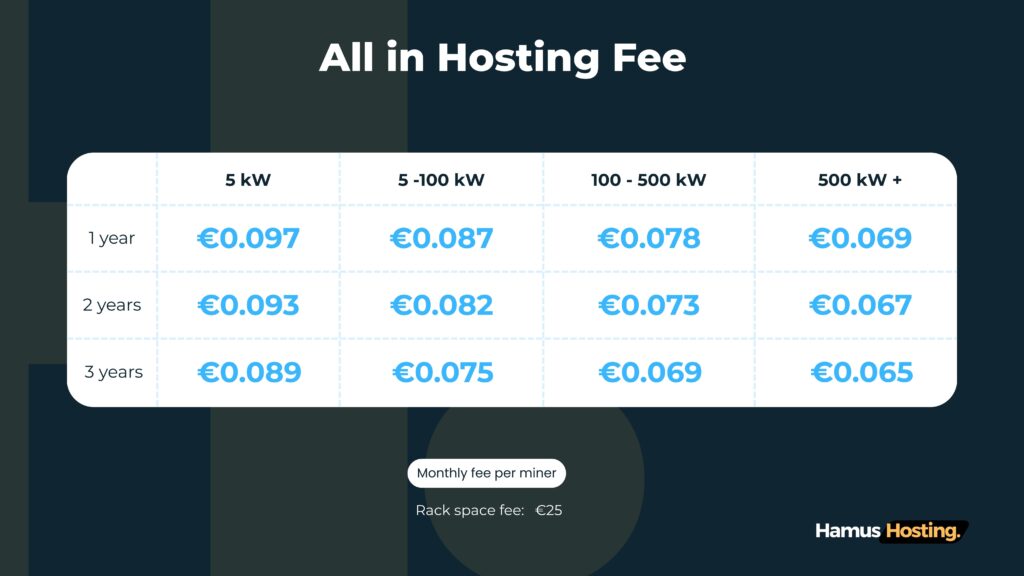
The all-in model is exactly what it sounds like — one bundled kWh rate that covers electricity, facility operations, on-site support, monitoring infrastructure, and all the services that keep your miners running. There are no separate setup fees or one-time charges. You pay a single rate per kWh consumed, plus a monthly rack space fee of €25 per miner. Rates scale down with volume and contract length, rewarding larger fleets and longer commitments with meaningfully lower per-kWh costs.
2. Ultra low kWh rate
The ultra low model offers a significantly lower kWh rate in exchange for one-time setup fees paid upfront per miner. This structure suits operators who plan to run their machines for multiple years and want to minimise their ongoing electricity cost — the lower rate compounds into real savings over time. The one-time fees cover the physical work of installing your miner, checking its condition, and reserving your slot in the facility.
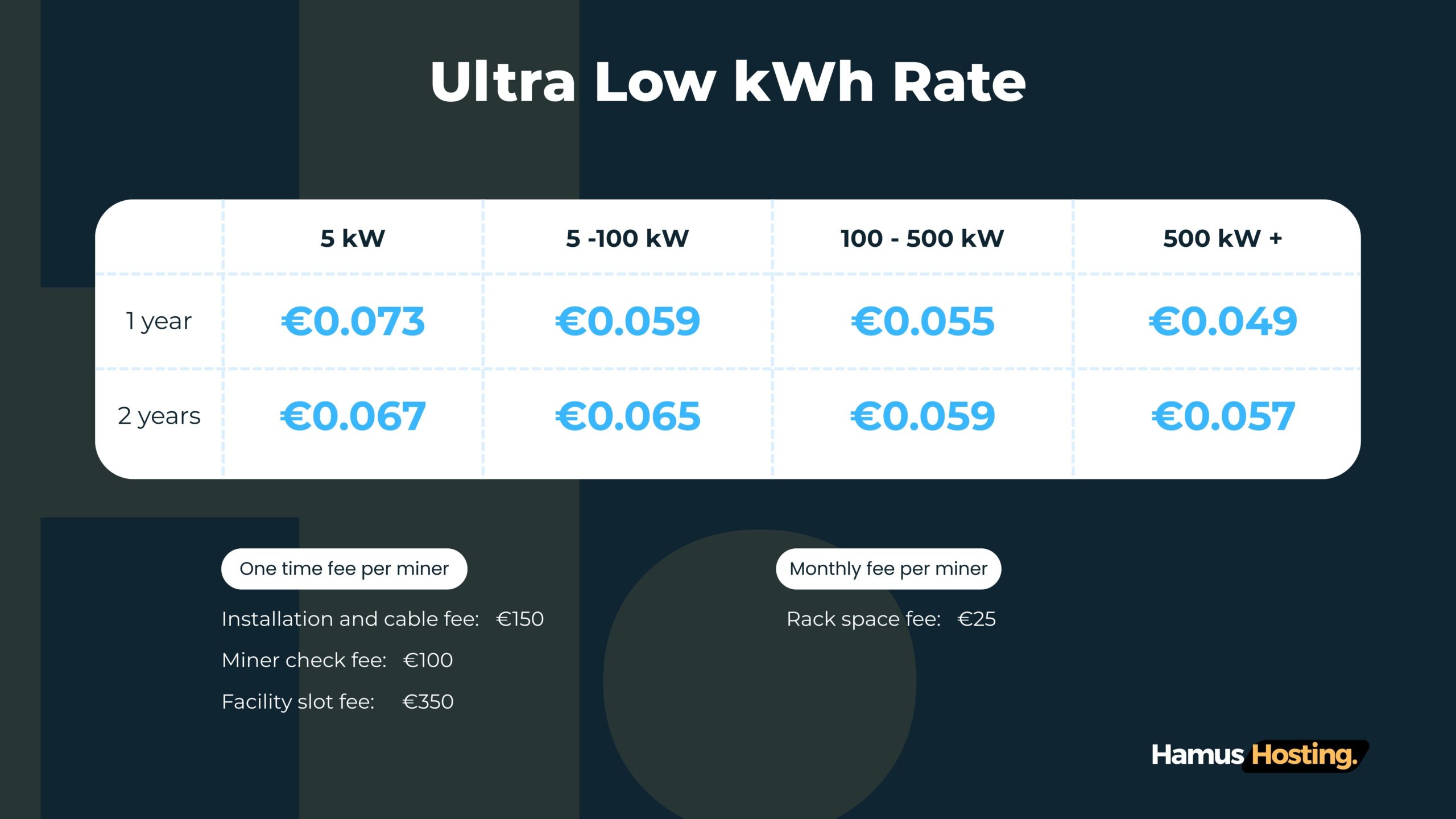
The one-time fees, are not a recurring cost. For miners planning to host for a full year or more, the lower kWh rate on the ultra low plan typically offsets the upfront cost within a few months — depending on the power draw of your hardware.
How to calculate your monthly hosting cost
The formula is straightforward. Your monthly electricity cost is calculated as:
Machine wattage (kW) × kWh rate × 24 hours × 30.5 days = monthly electricity cost
To that, you add the monthly rack space fee of €25 per miner. For the ultra low plan, you also factor in the one-time setup cost of €600 across the life of your contract to understand the true total cost of hosting. Let us walk through two real examples using the Antminer S21 Pro. See examples below.
Example: Antminer S21 Pro · All-in plan · 1 miner · 5–100 kW tier · 1 year
Antminer S21 Pro — 3,510W (3.51 kW)
Antminer S21 Pro · Ultra low plan · 1 miner · 5–100 kW tier · 1 year
Antminer S21 Pro — 3,510W (3.51 kW)
The comparison illustrates the core trade-off clearly: the all-in plan has zero friction to get started, while the ultra low plan rewards commitment with lower long-term costs. For a single miner on a one-year contract, the saving is meaningful. For a fleet of ten or more machines on a multi-year contract, the difference compounds significantly.
Which plan is right for you?
The all-in plan suits miners who are new to hosting, want simplicity, or prefer not to pay upfront costs per machine. It is also the natural fit if your fleet size or hosting duration is uncertain. The ultra low plan suits operators who are confident in their hardware, committed to a multi-year strategy, and want to drive down their per-kWh cost as low as possible to maximise Bitcoin yield per machine.
If you are unsure which structure works best for your specific fleet size and contract length, the Hamus Hosting team offers a free consultation call where they can walk through the numbers with you directly.
Ready to calculate your hosting cost?
Book a call with the Hamus Hosting team or view full hosting options.
Start mining today!
We’ve simplified the process to make mining crypto easier than ever. Fill in your details in the form and we will contact you shortly!