Mining Difficulty of Zcash (ZEC) Holds Steady Despite Increased Hashrate
The demand for the Antminer Z15 Pro has been relentless. Since the new May batch was released, the price of the machine has climbed by almost 50%. And the demand hasn’t slowed down despite these prices. More Z15 Pros are being plugged into the network, which means the total hashrate is growing.
And yet the mining difficulty has barely moved.
Normally, more hashrate means higher difficulty. So why is the mining difficulty flattened? And what does it mean for Zcash miners right now?
We have looked into the ZEC mining difficulty chart from CoinWarz and 2Miners. This is what we’ve found
What Is the Mining Difficulty of Zcash (ZEC) in Mid-2026?
We checked two independent difficulty sources. When you search for “Zcash mining difficulty,” the two most popular charts come from CoinWarz and 2Miners. Both track the same network, but they measure and display difficulty slightly differently. We pulled data from both to get a more complete picture.
CoinWarz (snapshot from May 13, 2026) reported ZEC difficulty at 138.78 million at block 3,163,959. The site also showed something remarkable: the difficulty change over the last 24 hours was 0.00%. The change over the last 7 days was 0.00%. The last 30 days: 0.00%. The last 90 days: 0.00%.
A perfectly flat line for three months.
2Miners (live reading from May 19, 2026) showed difficulty at 132.27 million, with a network hashrate of 12.33 GS/s.
That’s a gap of about 6.5 million between the two sources. Zcash difficulty adjusts on every single block, roughly every 75 seconds. Unlike Bitcoin, which adjusts difficulty every two weeks, ZEC is constantly recalibrating.
CoinWarz snapshots at a specific block height, while 2Miners uses a rolling average that smooths out short-term spikes and dips. They’re measuring the same heartbeat with different instruments.
Both sources tell the same macro story: ZEC difficulty peaked around 155 million in November 2024, dropped about 10–15% after the halving, and has been flat in the 132–140 million range ever since.
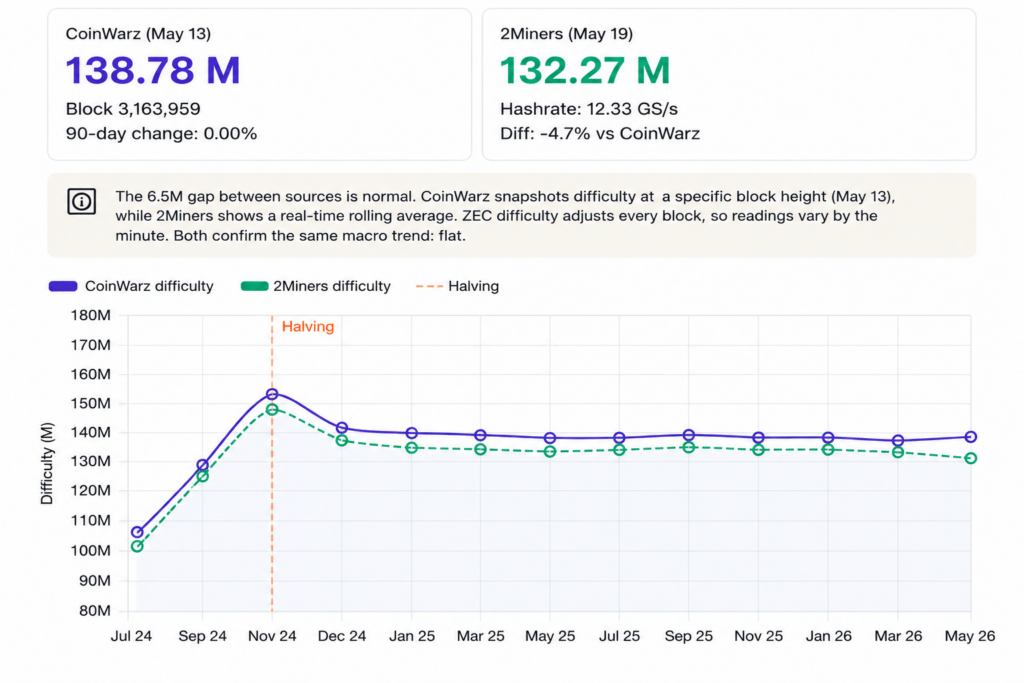
That’s a gap of about 6.5 million between the two sources. Zcash difficulty adjusts on every single block, roughly every 75 seconds. Unlike Bitcoin, which adjusts difficulty every two weeks, ZEC is constantly recalibrating.
CoinWarz snapshots at a specific block height, while 2Miners uses a rolling average that smooths out short-term spikes and dips. They’re measuring the same heartbeat with different instruments.
Both sources tell the same macro story: ZEC difficulty peaked around 155 million in November 2024, dropped about 10–15% after the halving, and has been flat in the 132–140 million range ever since.
What Happened in November 2024? and Why It Still Matters Today
On November 23, 2024, at block 2,726,400, Zcash went through its second halving. The block reward was cut from 3.125 ZEC to 1.5625 ZEC per block.
That’s a 50% reduction in the amount of new ZEC entering circulation with every block. What it means for miners is that each block produced half as many coins as before, just overnight.
What happened to the mining difficulty afterwards was interesting. As many expected a miner exodus. When rewards get halved, less efficient operators typically shut down, causing difficulty to drop as hashrate leaves the network.
That did happen, but only partially. Difficulty dropped from its ~155M peak to around 138–140M and then stabilised. The miners who stayed were the ones with efficient hardware and low electricity costs. They didn’t leave, and they haven’t been joined by significant new competition either.
After the halving, the hashrate of the network remained virtually unchanged. Miners did not capitulate after the reward reduction. The operators who are in right now are the committed ones.
And that likely brings us to the current moment.
Timeline: Key Events Affecting Difficulty
|
Date
|
Event
|
|---|---|
|
Jul 2024
|
ZEC at €14. Difficulty ~105M. Low interest, low hashrate.
|
|
Sep 2024
|
Pre-halving anticipation. Miners add hashrate. Difficulty climbs to ~130M. |
|
Nov 2024
|
Halving at block 2,726,400. Reward: 3.125 → 1.5625 ZEC. Difficulty peaks ~155M. |
|
Dec 2024
|
Post-halving adjustment. Some miners exit. Difficulty drops ~10% to ~140M. |
|
Q1 2025
|
Stabilisation. Remaining miners committed. Difficulty settles at ~138M. |
|
Q2–Q4 2025
|
ZEC price surges from €103 to €603. Difficulty barely moves (136–140M range). |
|
Q1 2026
|
Price corrects to ~€327. Difficulty stays flat. No miner capitulation. |
|
May 2026
|
ZEC recovers to €452. Difficulty still flat at 132–139M depending on source. |
So How Much ZEC Does a Z15 Pro Actually Mine Right Now?
Let’s run the numbers at current difficulty, using the CoinWarz mining calculator as a baseline. These figures assume the Z15 Pro running at its rated 840 KSol/s hashrate.
At current difficulty (~138M) and current ZEC price (~€452). Let’s look at the metric and value.
At a higher electricity rate like €0.086/kWh (typical for many commercial facilities outside of the Nordics), the daily electricity cost rises to about €5.74, and the daily figure drops to around €30–35. Still viable, but the margin narrows considerably.
The key insight here: your electricity rate is the single biggest variable you can control. Difficulty and ZEC price are market-driven. Energy cost is an operational decision.
As of May 21, 2026, Mining Now calculated the Z15 Pro generating ~€44.88 daily at €0.059/kWh on ASIC Miner Value.
Minerstat reported approximately €41.87 daily in gross revenue. The variation comes from slightly different difficulty readings and price feeds, but they all cluster around the same ballpark.
Why Is the Z15 Pro Miner Price Climbing?
If you’ve been shopping for a Z15 Pro recently, you’ve noticed the prices are not what they were a month ago. Since the start of May, the market price of the Z15 Pro has increased by roughly 50%.
This is a direct consequence of ZEC’s price performance. When ZEC was trading at €26–52, the Z15 Pro was a niche machine. At €452, it’s one of the most sought-after ASICs on the market.
Hardware prices follow demand. When an ASIC can cover its own cost in under six months, demand spikes, supply tightens, and prices rise. We actually wrote about this dynamic in April when new Z15 Pro batches were announced, the surge in ZEC mining activity had pushed both the Z15 and Z15 Pro completely out of stock worldwide, and the new April/May batches were the first real opportunity to secure units again.
But here’s the part that matters for the difficult discussion: every Z15 Pro that gets plugged in adds 840 KSol/s to the network hashrate. And when network hashrate goes up, difficulty usually follows.
We’ve been tracking the Zcash ecosystem closely for a while and it will be interesting to see how the Zcash network responds in the coming months.
What Does This Mean for Someone Considering a Z15 Pro Right Now?
The case for buying now
Difficulty is at historic lows relative to price. The Z15 Pro is generating €36+/day at current rates. Breakeven is under 6 months at competitive electricity rates. Every day you’re not mining is ZEC you’re not accumulating. And if difficulty rises — which it likely will as new machines ship — the current window closes.
The case for caution
Z15 Pro prices have jumped 50% in May. You’re paying a premium for hardware that was cheaper a month ago. If ZEC price corrects significantly (it hit ~€644 in November 2025 before pulling back to ~€327 by April 2026), the economics shift and that expensive machine takes longer to cover its cost. Difficulty could also spike if a large batch ships simultaneously, diluting everyone’s output.
The case for hosting over home mining
One Z15 Pro draws 2,780W continuously and runs at approximately 72–75 dB. That is roughly the volume of a vacuum cleaner that would run 24/7. Mining at it at home requires a dedicated 240V/20A circuit, professional installation, and a space where constant noise and heat output won’t be a problem. Most people choose professional hosting because of this practical reason.
At Hamus Hosting, we operate mining hosting facilities in Northern Norway powered by hydroelectric and wind energy at rates starting from €0.059/kWh (5-100 kWh tier) with no VAT under international export rules for private clients. One Z15 Pro, one hosting contract, and you’re mining ZEC.
Disclaimer: This article is for informational purposes only and does not constitute financial advice. Mining output depends on variables including ZEC price, network difficulty, electricity costs, and hardware availability, all of which can change rapidly. Always conduct your own research before making any decisions. Parts of the data analysis were produced with the assistance of Claude AI. All EUR figures are approximate conversions at ~€1 = $1.16 (May 2026 rate) and will fluctuate. Data referenced in this article was sourced from CoinWarz, 2Miners, BitInfoCharts, Mining Now, ASIC Miner Value, and Minerstat between May 13–19, 2026.

Book a call with Christiaan
We’re here to help! Schedule a 30 minutes call at your convenience.
FAQ: ZEC mining difficulty 2026
What is the current Zcash mining difficulty?
As of mid-May 2026, ZEC difficulty is between 132–139 million depending on the source, with CoinWarz reporting 138.78M and 2Miners showing 132.27M. Difficulty has been flat for over 90 days.
How much ZEC does an Antminer Z15 Pro mine per day?
At current difficulty, a Z15 Pro (840 KSol/s) mines approximately 0.080 ZEC per day, worth roughly €36–41 at current prices. At €0.059/kWh electricity, the net figure is approximately €32–37 per day.
How long does it take to mine 1 ZEC with a Z15 Pro?
At current difficulty (~138M), it takes approximately 12.5 days to mine 1 full ZEC with a single Antminer Z15 Pro running at 840 KSol/s.
Will Zcash mining difficulty increase?
Difficulty is likely to increase as new Z15 Pro machines ship and come online. Higher network hashrate directly causes higher difficulty. The current flat difficulty is a temporary window that will close as new capacity enters the network.
When is the next Zcash halving?
The next ZEC halving is projected for late 2028 at block 4,406,400, which will reduce the block reward from 1.5625 ZEC to 0.78125 ZEC.
Start mining today!
We’ve simplified the process to make mining crypto easier than ever. Fill in your details in the form and we will contact you shortly!